
In the e-commerce packaging industry, every square centimetre of kraft paper that moves through a production line carries a hidden cost — one that most operations teams rarely stop to calculate: the true cost of printing a single QR code.
For packaging converters running multiple shifts around the clock, this seemingly small number compounds into a significant overhead. A handful of companies across India’s booming ecommerce packaging sector recently made the switch to the Maplejet Hx Ultro 25W — and the results reveal a clear and repeatable pattern worth examining.
The problem with “good enough” printing
Thermal inkjet (TIJ) technology has long been the default choice for variable-data printing on packaging lines. It’s familiar, widely available, and works adequately at modest volumes. But “adequate” starts to look very different when a production line runs 24 hours a day, 365 days a year, at speeds of 70 metres per minute or more.
The companies in this study weren’t experiencing catastrophic failures with their previous systems — there were no major nozzle blow-outs or quality crises. The problem was subtler: the economics simply didn’t scale. As QR-code print volumes climbed to hundreds of thousands of impressions per ink cycle, the cost-per-print of cartridge-based systems became increasingly difficult to justify.
“The primary driver for change wasn’t a technical failure — it was a financial one. When you’re printing at industrial scale, every fraction of a paisa per print matters enormously.”
The other challenge was operational control. In a multi-shift environment where three different teams of operators interact with the same machine across a 24-hour cycle, the absence of granular user management and predictive ink monitoring creates real risk — both for print consistency and for unplanned downtime.
What the move to the Hx Ultro 25W actually changed
The shift from cartridge-based TIJ to the Maplejet Hx Ultro 25W’s bulk-ink architecture is not simply a technology upgrade — it’s a change in the fundamental economics of inkjet printing.
A cartridge system bundles the printhead with the ink supply. Every time the ink runs out, ou’re also replacing the delivery mechanism — a design that made sense for low-volume applications but introduces unnecessary cost at industrial throughputs. The Ultro 25W separates these two elements: a precision printhead with an extended service life operates independently of a bulkink reservoir that is replenished as needed. The result is a significantly lower cost per millilitre of ink and, crucially, a lower cost per impression.
Across all sites studied, this architectural difference translated into a meaningful and consistent reduction in consumable spend — not as a one-time saving, but as a structural improvement to the ongoing cost base of each operation.
The software features that made the real difference
Cost savings were the headline result, but the operators and owners of these facilities were equally clear about the value of two specific software capabilities built into the Ultro 25W platform.
� User access levels
In a three-shift, round-the-clock operation, multiple operators interact with the same machine every day. Without defined access controls, any operator can change critical print parameters — font size, position, content logic — whether intentionally or accidentally. The Ultro 25W’s tiered user access system allows managers to assign role-specific permissions, so operators can run jobs and clear minor faults without ever touching settings they shouldn’t. This single feature significantly reduced the risk of unauthorised parameter changes across all sites.
📊 Ink estimation
Running out of ink mid-shift on a continuous production line is an avoidable problem — but only if you have visibility into consumption trends before they become a crisis. The Ultro 25W’s integrated ink estimation tool gives production and procurement teams a live, data-driven view of remaining ink life relative to current print volumes. All facilities highlighted this as a key benefit: the ability to schedule replenishment proactively, rather than reacting to an unexpected stoppage.
These aren’t add-on features or premium upgrades — they are native to the platform, available from day one. For operations running continuously without a break, that kind of built-in Governance and visibility is not a luxury; it is a requirement.
The outcomes across every site
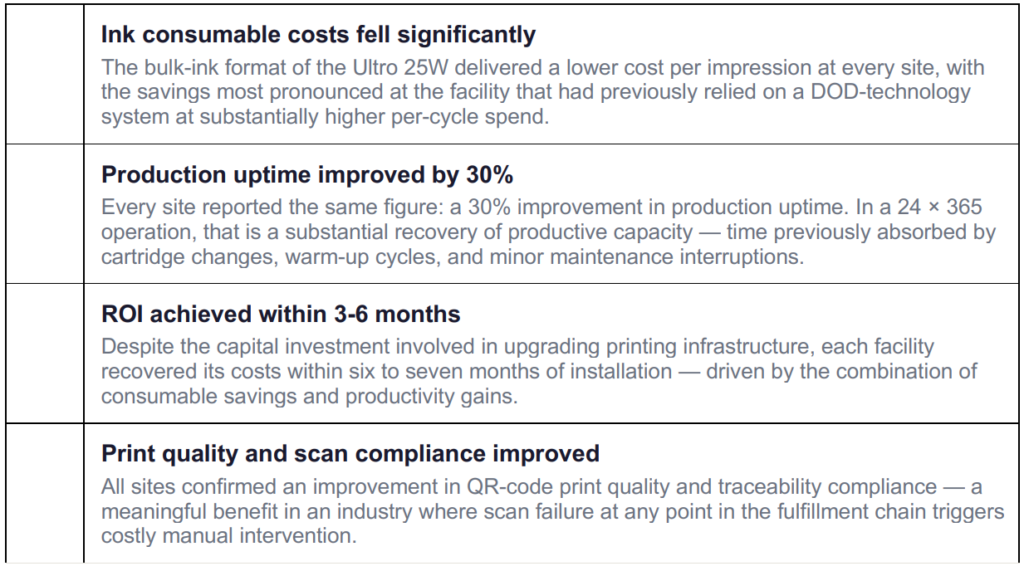
All facilities completed independent assessments of their results after switching to the Hx Ultro 25W. While specific numbers varied by site — reflecting different line speeds, code sizes, and previous system costs — four outcomes were consistent across every location:
What this means for other packaging converters
The facilities featured in this study are representative of the broader e-commerce packaging sector in India: running high-volume, continuous operations on kraft paper substrates, printing QR codes at scale, managing multi-shift workforces, and facing constant pressure to reduce per-unit costs without sacrificing quality or compliance.
If your operation shares those characteristics — and is currently running on a cartridge-based TIJ or legacy DOD system — the data from these sites suggests a straightforward starting point: calculate your actual cost per print today, and compare it to what bulk-ink architecture can deliver at your throughput. The gap is likely larger than you expect.
Beyond the economics, ask whether your current system gives your production managers the governance tools they need to run a tight, controlled operation across multiple shifts. User access levels and predictive ink estimation are not niche requirements — they are the baseline of a well-run modern printing operation.
This article is based on findings from a structured multi-site study conducted with e-commerce ackaging converters operating the Maplejet Hx Ultro 25W. All participating companies have consented to their results being used in Maplejet’s published materials.





Recent Comments