
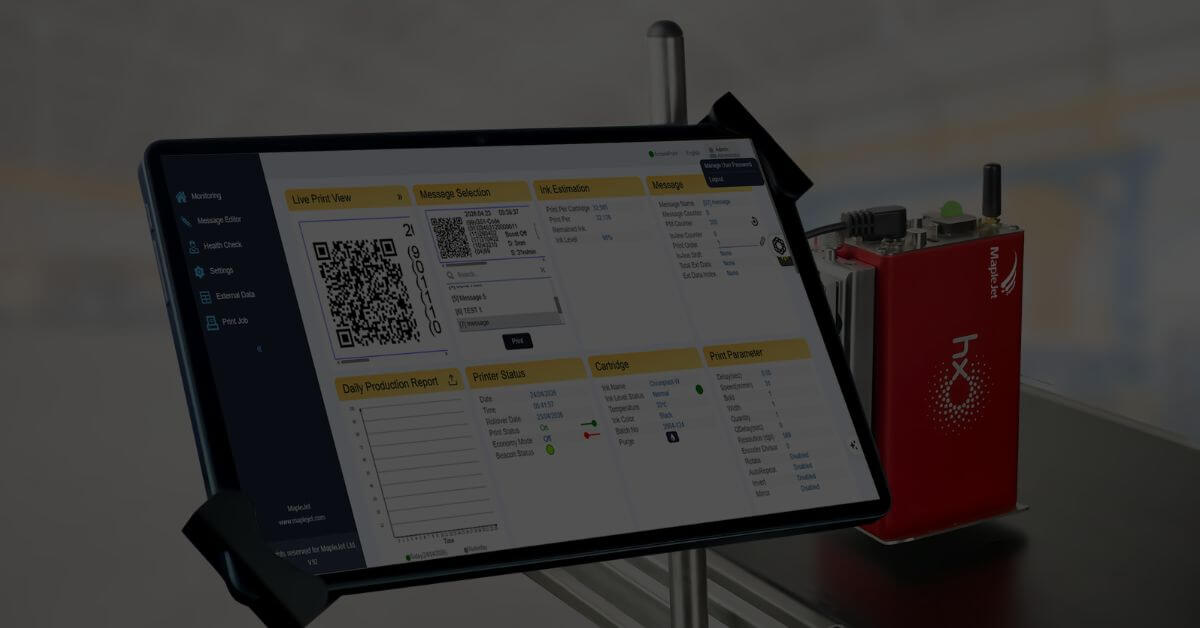
In every regulated manufacturing environment — food production, pharmaceutical packaging, FMCG, cosmetics — one rule is non-negotiable: every product batch that leaves the production line must carry a traceable batch code. That code is the link between the product on the shelf and the production record in your system. When something goes wrong, it is the difference between a targeted, managed recall and a costly, brand-damaging blanket withdrawal.
The equipment that prints that code is a batch code printer. In this guide, MapleJet explains what batch code printers are, how they work, which technology performs best on which substrate, and how the Hx product range addresses the most common batch coding challenges faced by production managers, quality teams, and packaging engineers.
What is a batch code printer?
A batch code printer is an industrial marking device that prints unique batch identification data — such as batch numbers, lot codes, production dates, shift codes, and traceability barcodes — directly onto product packaging at production line speed, without contact with the packaging surface.
Batch code printers are integrated directly into production lines. As each product passes the printhead, the printer fires ink droplets onto the packaging surface, producing a clear, permanent, machine-readable code that identifies the production batch. The code can be as simple as a four-digit number or as complex as a full GS1 DataMatrix barcode containing batch number, expiry date, serial number, and product identifier simultaneously.
KEY DISTINCTION: A batch code printer prints directly onto the packaging at production speed. It is not a label printer. Direct inkjet batch coding is faster, lower cost per unit, and more tamper-evident than batch coding via adhesive labels.
Batch codes vs lot codes: what is the difference?
In manufacturing, the terms batch code and lot code are used interchangeably across most industries. Both refer to a unique alphanumeric identifier assigned to a group of products manufactured under the same conditions, at the same time, from the same materials.
The precise terminology varies by industry and by region. Pharmaceutical manufacturers tend to use the term lot code or lot number, as required by regulatory bodies such as the FDA and EMA. Food manufacturers typically use the term batch code, date code, or production code. FMCG and cosmetics manufacturers use both interchangeably. The function is identical: to link a finished product back to its production record for traceability, quality control, and recall management.
REGULATORY NOTE: The FDA Food Safety Modernization Act (FSMA) and equivalent regulations in the EU, UAE, Saudi Arabia, India, and other markets require that batch or lot codes be printed legibly and durably on primary packaging. The specific format requirements vary by product category and market.
Why batch coding is a regulatory requirement
Product recall management
When a safety issue, contamination, or quality defect is identified, regulators require manufacturers to withdraw all affected product from distribution. Without accurate batch codes printed at the point of manufacture, identifying and locating affected products across a distribution network is impossible. Clear, legible, machine-readable batch codes enable a targeted recall that minimises waste, cost, and reputational damage.
Supply chain traceability
Modern supply chain standards — including GS1 traceability requirements, FSMA Section 204, and EU Regulation 2021/382 — require manufacturers to maintain records linking each batch of finished product to raw material inputs, production conditions, and distribution destinations. Batch code printers that integrate with ERP and manufacturing execution systems make this traceability automated rather than manual.
Consumer safety and brand protection
A missing, smudged, or illegible batch code is a visible quality failure. Major retailers including supermarket chains and pharmaceutical distributors reject deliveries with non-conforming batch marks. A reliable industrial batch coder protects your brand at the point of supply chain entry.
Regulatory market access
In many markets, products without clear batch coding are barred from retail or pharmacy shelves. Gulf Cooperation Council (GCC) markets, the European Union, and export markets across Southeast Asia all require compliant batch and lot coding as a condition of market entry. Your batch code printer is part of your regulatory compliance infrastructure.
GS1 SUNRISE 2027: From January 2027, GS1 standards require all retail point-of-sale barcodes to support 2D scanning. Batch code printers that print GS1 DataMatrix codes alongside batch numbers and expiry dates future-proof your packaging lines for this transition. MapleJet’s Hx range supports full GS1 DataMatrix printing at 600 DPI.
MapleJet batch code printers: full product range
MapleJet manufactures a complete range of batch code printers covering every production environment — from startup food producers on small lines to multi-shift pharmaceutical facilities running 24 hours a day — and every packaging substrate, from flexible films to glass bottles to corrugated outer cases.
Hx Nitro — TIJ batch coder for primary packaging
The Hx Nitro is MapleJet’s flagship thermal inkjet (TIJ) batch code printer. It prints batch numbers, lot codes, expiry dates, barcodes, and GS1 DataMatrix codes at 600 DPI resolution with zero maintenance — no solvent cleaning, no warm-up time, no engineer callouts. Replace the ink cartridge and restart printing instantly.
| Technology | Thermal Inkjet (TIJ) |
| Print height | Up to 12.7 mm (0.5 inch) |
| Resolution | 600 DPI |
| Max print speed | 240 m/min (reduced resolution) |
| Print lines | Up to 6 lines at 2 mm per line |
| Message components | Text, date, time, batch number, lot number, shift code, logo, barcode, QR, GS1 DataMatrix, counter, external data, serial number |
| Ink types | Water-based, solvent, semi-solvent — broad substrate compatibility |
| Substrates | Porous and non-porous: PET, glass, metal cans, flexible films, cartons, plastics |
| Software | Hx Manager — web-based, accessible from any smart device |
| Connectivity | Wi-Fi, USB, RS-232; PLC, ERP, API integration |
| Certification | CE |
The Hx Nitro prints batch codes and lot numbers on:
- Food packaging: yogurt cups, snack wrappers, juice packs, dairy containers, meat and poultry trays
- Pharmaceutical packaging: tubes, glass vials, blister packs, pharmaceutical containers
- Cosmetics and personal care: soap, shampoo, lotion, perfume packaging
- Beverage bottles: PET and glass soft drinks, water, juice, energy drink bottles
- Industrial packaging: chemical containers, adhesive packaging, paint cans
Hx Nitro 25w — 1-inch batch coder for secondary packaging
The Hx Nitro 25w extends batch coding to 25 mm (1 inch) print height using water-based ink, making it ideal for outer carton and secondary packaging batch coding on porous substrates including corrugated cardboard, kraft paper, and paper sacks.
| Technology | Thermal Inkjet (TIJ) |
| Print height | 25 mm (1 inch) |
| Ink type | Water-based pigment |
| Substrates | Porous and semi-porous secondary packaging |
| Best for | Outer carton batch coding, e-commerce box marking, warehouse coding |
Hx Ultro — CTIJ batch coder for high-volume production
The Hx Ultro is MapleJet’s Continuous Thermal Inkjet (CTIJ) batch code printer, engineered for high-volume, multi-shift manufacturing lines. Its Advanced Ink System (AIS) feeds ink continuously from a bulk supply, eliminating cartridge change interruptions and ensuring uninterrupted batch coding across long production runs.
| Technology | Continuous Thermal Inkjet (CTIJ) |
| Print height | 12.7 mm (0.5 inch) or 25 mm (1 inch) |
| Resolution | Up to 600 DPI |
| Max print speed | 240 m/min (reduced resolution) |
| Ink supply | Bulk ink via Advanced Ink System (AIS) — multiple capacities |
| Substrates (600s) | Non-porous: flexible films, glass, PET, pharma, cosmetics |
| Substrates (600w / 25w) | Porous: FMCG cartons, corrugated, sacks, e-commerce |
| Management | Hx Manager + Hx Console — centralized multi-printer monitoring |
| Integration | ERP, CRM, API, PLC, Wi-Fi networking |
| Best for | High-volume 24/7 pharma, FMCG, food and beverage lines |
Hx Cartro — carton and case batch coder
The Hx Cartro is a compact drop-on-demand (DOD) batch code printer designed for outer carton and case coding on secondary packaging lines. Its cassette-based ink system handles batch numbers, lot codes, barcodes, and product data on corrugated boxes at up to 40 m/min.
| Technology | Piezo Inkjet (PIJ) Drop-on-Demand |
| Print height | 18 mm (0.7 inch) or 36 mm (1.4 inch) |
| Resolution | 180 DPI |
| Max print speed | 40 m/min |
| Ink type | Oil-based: Black, Blue, Red |
| Substrates | Corrugated cartons, cardboard, secondary packaging |
| Best for | Case batch coding, logistics cartons, outer case marking |
Hx Megalo — large character batch coder
The Hx Megalo is MapleJet’s large-format batch code printer. With a print height of up to 70 mm (2.7 inches), it handles bold, high-visibility batch codes and product identification marks on outer cases, industrial goods, pipes, sacks, and large-format packaging at up to 120 m/min.
| Technology | Piezo Inkjet (PIJ) |
| Print height | Up to 70 mm (2.7 inches) |
| Resolution | 180 DPI |
| Max print speed | 120 m/min |
| Ink types | Oil-based, UV |
| Best for | Large character carton coding, FMCG outer cases, industrial marking |
Choose the right MapleJet batch coder for your line
The right batch code printer depends on four factors: substrate type, required print height, production line speed, and print volume. Use this guide to identify the best fit for your application.
| Application | Recommended printer | Why |
| Batch codes on PET bottles, glass, metal cans, flexible films | Hx Nitro | 600 DPI TIJ, high throw distance with eUrex ink, zero maintenance, instant restart |
| Lot codes on pharmaceutical blister packs, vials, tubes | Hx Nitro / Hx Ultro 600s | 600 DPI for small text and GS1 DataMatrix on non-porous pharma packaging |
| Batch coding on FMCG flexible pouches and laminates | Hx Ultro 600s / Hx Nitro | High-resolution CTIJ or TIJ for non-porous flexible substrates |
| Outer carton batch coding on secondary packaging lines | Hx Cartro / Hx Nitro 25w | DOD or 25 mm TIJ for corrugated cartons and kraft packaging |
| Large character batch numbers on corrugated cases and sacks | Hx Megalo | 70 mm print height, 120 m/min, bold visibility on large packaging formats |
| High-volume 24/7 batch coding — pharma or FMCG lines | Hx Ultro (CTIJ) | Bulk ink, AIS, no cartridge interruptions, centralized management |
| Batch codes on industrial products, pipes, cables, extrusions | Hx Evo | 18 mm PIJ, solvent/UV inks, built for continuous industrial production |
Batch code printing with Hx Manager: Automation and Traceability
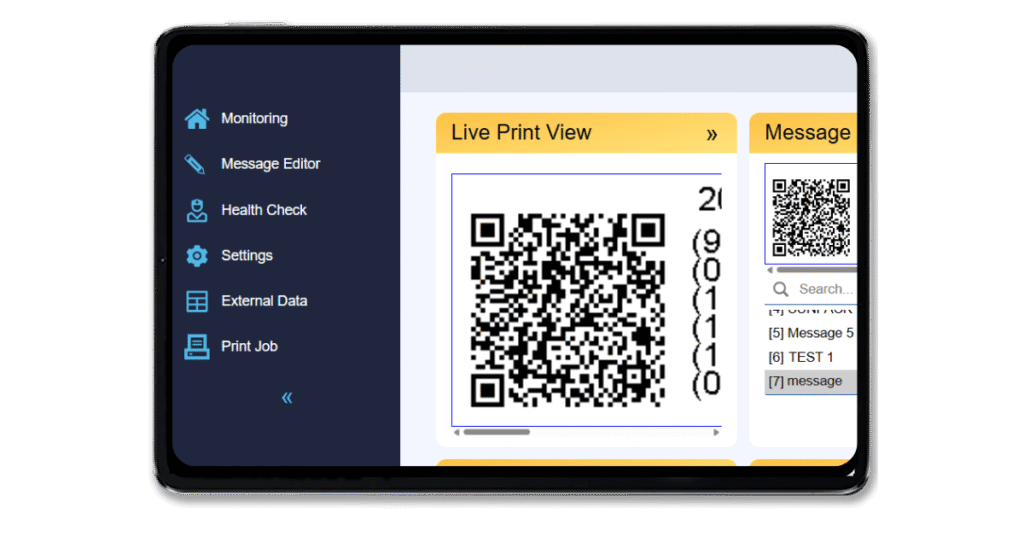
Printing a batch code is only half the task. The other half is managing the data: ensuring the right batch number reaches the right printer at the right time, without operator error, and with a complete digital record of what was printed, when, and on which line.
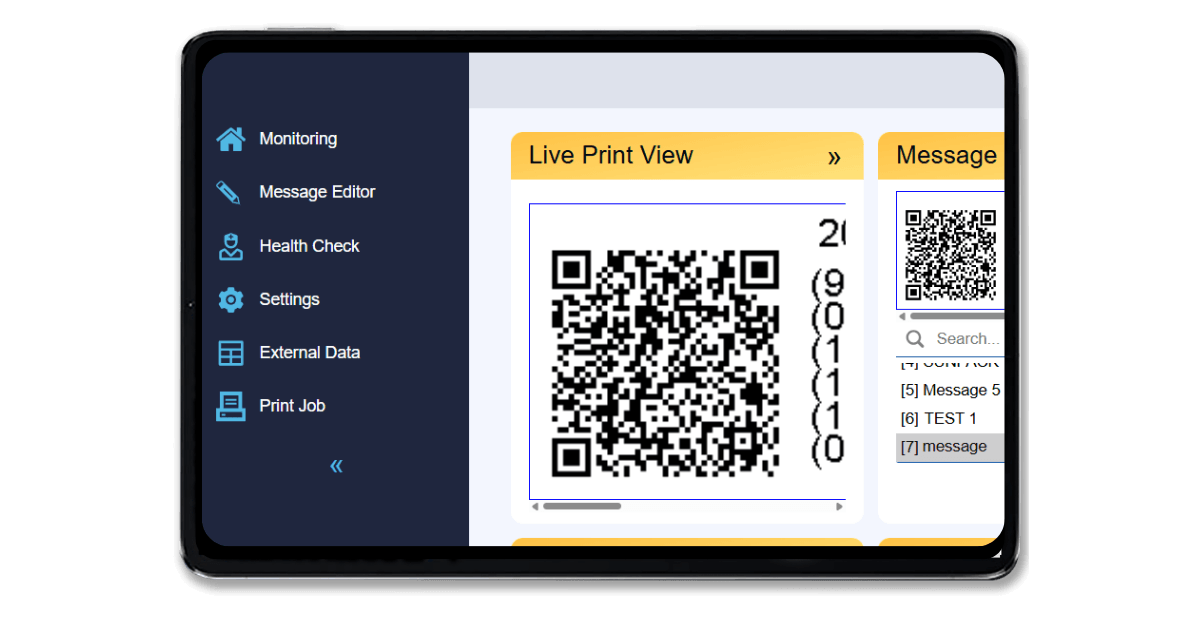
Every MapleJet Hx printer is managed through Hx Manager — a web-based software platform accessible from any smartphone, tablet, laptop, or PC via Wi-Fi, without any application installation. Hx Manager handles the full batch coding workflow:
- Message design and variable data: Design batch code messages including batch number, lot code, expiry date, shift code, barcode, GS1 DataMatrix, and external data fields in a single template.
- External data integration: Connect directly to your ERP, MES, weighing scale, PLC, or barcode reader. The printer receives variable batch data automatically — no manual input required.
- Multi-printer management: Design a message once and send it to multiple printers on multiple lines simultaneously via the Send to Many feature.
- Real-time monitoring: Monitor printer status, ink levels, print counts, and health diagnostics in real time from any device on the same network.
- Daily production reports: Hx Manager generates hourly and daily print reports providing a complete audit trail of batch coding activity for each production line.
- Auto Notify alerts: Automatic alerts for low ink, print completion, and online data updates via USB, RS-232, or Wi-Fi.
- Economy Mode: Ink consumption reduced by up to 50% to increase print quantity per cartridge.
For multi-line facilities, Hx Console extends this capability to centralized management of an entire network of printers simultaneously — providing executives and production managers with a single dashboard covering all printers, all lines, and all batch coding activity across the facility.
ERP AND API INTEGRATION: If your facility uses SAP, Oracle, or another ERP or MES platform, MapleJet’s dedicated API enables direct integration — sending batch data from your production system to the printer automatically, with no manual intervention and a complete digital audit trail at every stage.
Industries that rely on batch code printers
Food manufacturing
Food manufacturers are required to print batch codes and lot numbers on primary packaging to support product traceability, recall management, and best-before date compliance. MapleJet’s Hx Nitro handles the full range of food packaging substrates — PET trays, flexible films, glass jars, metal cans, paper wrappers — with food-safe ink options and 600 DPI print quality.
Pharmaceutical manufacturing
Pharmaceutical lot coding demands the highest print resolution and the most rigorous traceability standards. Lot numbers, batch codes, expiry dates, and GS1 DataMatrix serialisation codes must be printed legibly on blister packs, vials, ampoules, tubes, and secondary cartons. The Hx Nitro and Hx Ultro 600s deliver 600 DPI output on non-porous pharmaceutical packaging with full ERP integration.
FMCG manufacturing
FMCG manufacturers operate high-speed, multi-SKU production lines where batch changeover speed, code accuracy, and ink downtime all directly impact throughput. MapleJet’s zero-maintenance TIJ and CTIJ printers eliminate service interruptions and enable rapid message changeover via Hx Manager — from any device, without stopping the line.
Cosmetics and personal care
Cosmetics manufacturers in regulated markets including the EU, GCC, and ASEAN are required to print batch reference codes and expiry dates on primary packaging. The Hx Nitro handles cosmetics substrates including tubes, pumps, glass bottles, and flexible sachets with solvent and semi-solvent inks designed for adhesion on non-porous coated surfaces.
Building materials and industrial
Pipes, cables, and construction materials require permanent, durable batch codes for quality traceability and specification compliance. The Hx Megalo and Hx Evo handle large-format batch coding on industrial substrates at high line speeds with UV-curable and solvent-based inks for maximum durability.
Frequently asked questions about batch code printers
What is a batch code printer?
A batch code printer is an industrial device that prints batch identification codes — including batch numbers, lot codes, production dates, and traceability barcodes — directly onto product packaging at production line speed, without contact with the packaging surface.
What is the difference between a batch code and a lot code?
Batch codes and lot codes refer to the same thing: a unique identifier assigned to a group of products produced under the same conditions at the same time. The term lot code is more commonly used in pharmaceutical manufacturing; batch code is more common in food and FMCG industries. Both serve the same traceability and recall management function.
Can a batch code printer also print expiry dates and barcodes?
Yes. MapleJet batch code printers print batch numbers, lot codes, expiry dates, production dates, shift codes, barcodes (all formats), QR codes, and GS1 DataMatrix codes — all within the same message template, at the same time, at up to 600 DPI resolution.
What substrates can a MapleJet batch coder print on?
MapleJet batch code printers cover porous substrates (corrugated cartons, paper sacks, cardboard) and non-porous substrates (PET bottles, glass, metal cans, flexible films, laminates, plastics) using the appropriate ink formulation from MapleJet’s industrial ink catalogue.
How does the Hx Manager connect batch data from our ERP to the printer?
Hx Manager connects to external data sources including ERP systems, weighing scales, PLC controllers, and barcode readers via Wi-Fi, RS-232, or USB. Once connected, batch data is sent to the printer automatically — no manual input required.
What is the maintenance requirement for a MapleJet batch code printer?
MapleJet TIJ batch code printers (Hx Nitro, Hx Nitro 25w) are maintenance-free. The printhead is integrated into the ink cartridge and replaced with it — there are no nozzles to clean, no solvents to handle, and no engineer service visits required. The Hx Ultro CTIJ system uses bulk ink with no cartridge interruptions, operating continuously with minimal operator intervention.
Does MapleJet offer a free batch code print sample?
Yes. Contact MapleJet or your local distributor to request a complimentary print sample on your specific packaging substrate. Our team will produce a sample demonstrating batch code quality, ink adhesion, and legibility for your application.
Request a free batch code print sample
Evaluating a batch code printer is easier when you can see the print quality on your own packaging. MapleJet offers complimentary print samples on request — simply provide your substrate type and batch code format, and our technical team will produce a sample using the appropriate ink and print parameters.
READY TO UPGRADE YOUR BATCH CODING? Contact MapleJet at sales@maplejet.com or visit www.maplejet.com/contact-us to request a print sample, arrange a live demonstration, or speak with a batch coding specialist. MapleJet serves manufacturers across North America, the Middle East, Europe, India, and Southeast Asia through a global distributor network.




Recent Comments