
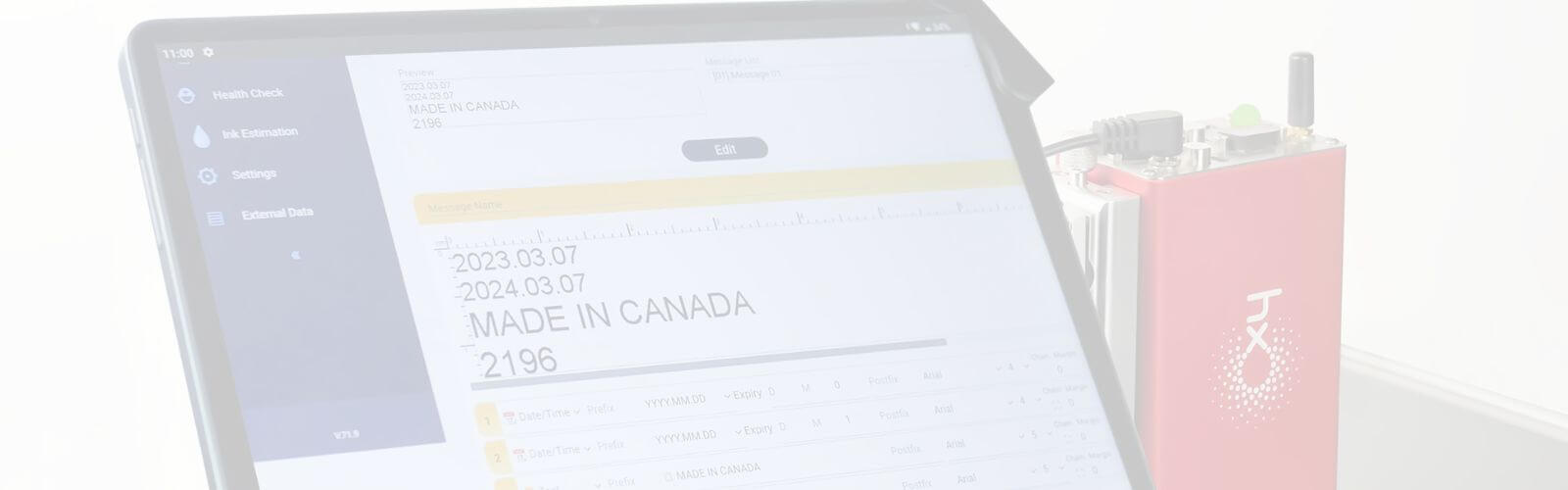
The Hx Platform: One Software Powering Every MapleJet Printer
Most manufacturers do not “choose one coding technology” and stay there forever.
As you expand product ranges, materials, and factories, you end up with a mixed fleet:
- Primary packaging lines that need clean, high-resolution codes at speed
- Secondary packaging lines that need readable codes and barcodes
- Industrial lines (pipe, extrusion, cable, metal) that need durable, permanent marks
The hidden cost is not always the printers. It’s the software fragmentation:
- Different user interfaces by technology
- Different training and SOPs by site
- Different monitoring screens and alarm logic
- Different ways to manage dates, shifts, counters, and barcodes
That’s exactly where the Hx Platform creates a platform-level advantage: one UI mindset across technologies, even when the print engine changes.
The platform-level advantage: one control layer, multiple print engines
The common layer is built around two elements that show up across Hx families:
- Hx Manager – for centralized message creation and individual printer control
- Hx Console – for centralized multi-printer monitoring and control
This matters because you can standardize how your people work, even when your factories run different technologies for valid reasons.
Same UI across technologies: what stays consistent (CTIJ, TIJ, PIJ, UV)
1) Web-based access (reduces “software installation” problems)
MapleJet consistently emphasize that no app installation is required and access is through a browser-enabled smart device
Why you should care: scaling from 1 line to 20 lines goes faster when IT isn’t re-installing software for every station.
2) Cross-device operation (the UI follows your team)
Operators and supervisors can use the same workflow across smartphones/tablets/laptops/PCs
Why you should care: training becomes “one interface, many devices” instead of “one printer = one learning curve.”
3) Real-time monitoring (less guessing, faster response)
Viewing printer status, ink levels, and production data is instant.
Why you should care: coding problems are cheaper to fix before they become scrap, rework, or a shipment hold.
4) Controlled access (fewer accidental edits)
Password-protected user management is a part of safe, controlled operation.
Why you should care: many “coding errors” are not technical failures—they’re incorrect changes made under pressure during a shift.
Where PIJ fits in a mixed-technology fleet (with Hx Evo & Hx Megalo)
PIJ (Piezo Inkjet) is typically added when your environment becomes more “industrial” and less “packaging-only.”
PIJ is commonly used when you need:
- Durable, legible printing on demanding substrates
- Non-contact coding on continuous or irregular lines
- More tolerance for challenging industrial conditions
For example, Hx Evo is an industrial-grade coding solution for pipes, extrusions, cables, and other continuous/irregular lines, designed for durability and consistent performance
How this ties to your installed base?
In your installed mix:
- Hx Evo (PIJ) is the PIJ workhorse for tougher substrates and continuous lines, while still using the same core UI expectations (web-based interface, monitoring, access control)
- Hx Megalo (PIJ) covers the “large character / high visibility” requirement, with UV options when durability on coated/non-absorbent surfaces is needed
Application context: what “easy scaling across factories” looks like
Here’s the real-world pattern the Hx Platform supports:
- Factory A runs Hx Ultro CTIJ on high-speed packaging lines
- Factory B runs Hx Nitro TIJ for simpler coding points and quick deployments
- Multiple sites use Hx Megalo where large, readable codes and branding are needed, and UV where substrates demand it
Without a shared platform layer, each site becomes “its own world.”
With shared workflows (Hx Manager + Hx Console), you can standardize:
- Message creation logic (templates, date rules, barcode formatting)
- Access levels (who can edit vs who can only run)
- Monitoring routines (what alarms matter, what “healthy operation” looks like)
Customer benefits
✔ Fewer errors
Most coding mistakes come from variation: different screens, different menu logic, different “print start” habits.
When your interface philosophy stays consistent—web-based, monitored, permission-controlled—the probability of human error drops
✔ Faster onboarding
When a trained operator moves from a TIJ station to a CTIJ or large-character station, they’re learning:
- The application differences (substrate, ink type, durability needs)
…but not re-learning the whole operating concept (access, message creation, monitoring).
✔ Easier multi-site scaling
A major platform advantage is keeping monitoring and control consistent across multiple printers and lines (centralized oversight.
Why “one platform” lowers total cost of ownership
Printer TCO is not just ink and parts. In multi-site operations, the bigger cost drivers are often:
- Training time and retraining
- Startup scrap / misprints during changeovers
- Downtime caused by slow troubleshooting
- The internal burden of supporting multiple systems
Hx systems also highlight integration capability—e.g., external devices like PLCs can send commands to the printer —which matters because scaling often includes automation and line control standardization, not only “more printers.”
Conclusion: the takeaway
With the Hx approach, you can build a mixed-technology strategy where:
- CTIJ stays the workhorse for high-volume packaging lines
- TIJ stays the simple, high-resolution option for straightforward coding points
- PIJ (Hx Evo) covers industrial substrates like pipes/extrusions/cables with durability and robustness
- (PIJ/UV) Hx Megalo handles large-character needs—and UV options handle coated/non-absorbent surfaces when permanence is required
One platform → fewer errors, faster onboarding, easier scaling across factories. That’s the platform-level advantage—without forcing one print technology into every application.



Recent Comments